
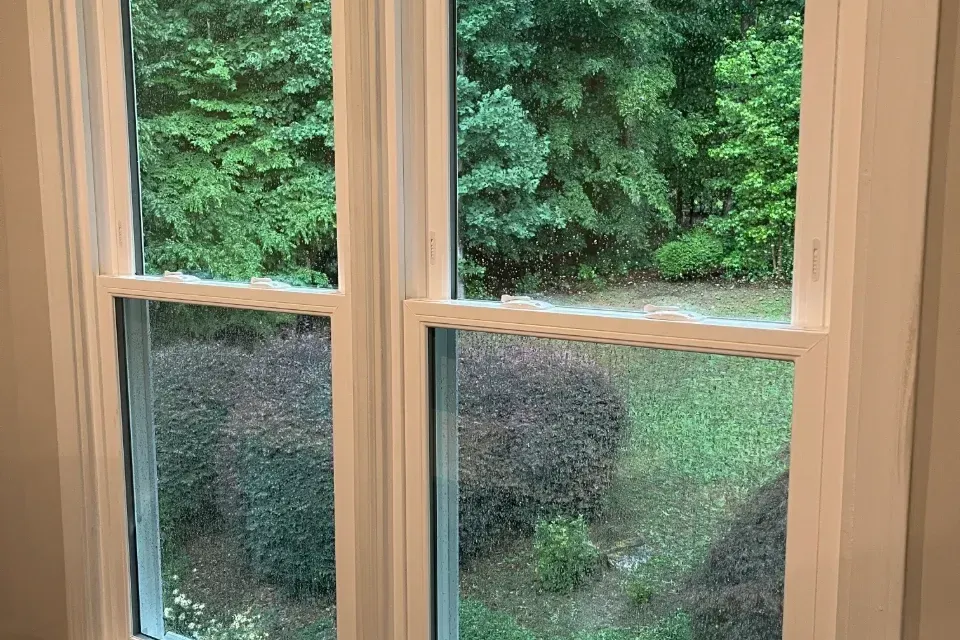
Drafty windows? Learn where the cold air gets in, easy ways to find a leak, which fixes to try first and how to tell when it’s time to replace the window.
In this article
The first chilly nights of November have a way of finding every weak spot in a house. You settle onto the couch by the window and feel it: a cold, steady breath of air that wasn’t there in September. Drafty windows make a room feel colder than the thermostat says and make your heating work harder.
Most leaks can be tracked down in a few minutes, and many can be fixed for a few dollars. Others are a sign that the window, or the way it was installed, has reached its limit. Here’s how to tell the difference before you spend money.
Is it a draft, or just a cold window?
A window can feel drafty even when no outside air is getting in. On a cold night, the glass cools the air next to it. That air sinks to the floor and spills into the room, and warmer air from near the ceiling moves in to replace it. As Green Building Advisor explains, you can feel a slight breeze even when the window isn’t leaking at all. Your body also loses heat to cold glass, so a seat by the window can feel chilly in perfectly still air. Cold glass is also where moisture shows up first, which our guide to window condensation explains.
A quick check: if the moving air comes down off the face of the glass, it’s the cold window effect. Caulk won’t help, but heavy curtains or cellular shades can, and better glass is the lasting fix. If it comes from the edges of the sash, the frame or the trim, you have a leak.
Where cold air comes through windows
- A sash that isn’t locked. On double-hung and sliding windows, the lock pulls the sashes tight against their seals. Without it, a window can leak even when it looks closed.
- Worn weatherstripping. The flexible seals around the sash flatten, crack or tear with years of use.
- Gaps at the meeting rail. Where the two sashes of a double-hung window meet is a classic leak, especially if they’ve shifted.
- Cracked exterior caulk. Caulk where the trim meets siding or brick cracks and pulls away with age, letting in air and, in a summer thunderstorm, water.
- Gaps behind the trim. The space between the window frame and the wall framing should be insulated and sealed when the window goes in. If it wasn’t, air slips around the frame and out from behind the interior trim.
- Warped, rotted or out-of-square frames. If the frame or sash has twisted, swollen or rotted, no seal can close against it.
How to do a window draft test
Pick a cool, windy day and work your way around each window:
- Look for daylight. Light showing around the sash or frame means air is getting through. Gently try to rattle the sash, too: the Department of Energy notes that movement means possible air leaks.
- Try the dollar-bill test. Close and lock the window on a dollar bill. If it slides out without any drag, the seal is loose at that spot. Repeat along the sides, the top and the meeting rail.
- Use incense or a smoke pencil. Pass a lit incense stick slowly around the sash, frame and trim. Where the smoke wavers or gets pulled sideways, there’s a draft. Hold a small dish under it, keep it well away from curtains and blinds, and skip the candle: an open flame near window treatments is a fire risk.
- Use a thermal camera if you have one. On a cold day, an infrared camera (some plug into a phone) shows leaks as cold streaks at corners, sash edges or trim.
To make small leaks easier to find, the Department of Energy’s guide to detecting air leaks suggests closing all windows, exterior doors and fireplace flues, then running exhaust fans that blow air outside, like bath fans and the range hood. As a safety step, DOE says to turn off combustion appliances such as gas furnaces and water heaters first.
How to fix drafty windows, from cheapest to biggest
Start with the fixes that cost little or nothing. You may not need the rest.
| Fix | What it solves | Good to know |
|---|---|---|
| Lock the sash | Loose sashes, meeting rail gaps | Costs nothing; do it every time |
| New weatherstripping | Worn seals around the sash | A DIY job on many windows |
| Caulk | Gaps around the frame and trim | Outside, it keeps water out too |
| Rope caulk | Leaks on windows you won’t open | Pulls off in spring |
| Shrink film kit | Leaky or single-pane windows | Window stays shut all winter |
| Heavy curtains | Chill from cold glass | Won’t stop a leak |
| Replacement | Worn-out or damaged windows | Fixes glass, seals and fit at once |
Lock the sash
It sounds too simple, but check it first. Locking a double-hung window pulls the sashes together at the meeting rail and presses them against their seals. If the lock no longer pulls them tight, the lock or the sash may need adjusting.
Replace worn weatherstripping
Weatherstripping windows is one of the cheapest fixes there is. The Department of Energy’s do-it-yourself guide to weatherstripping double-hung windows uses V-channel weatherstripping and self-adhesive foam, and rates it a moderate project that takes about an hour and costs $5 to $10.
Re-caulk the gaps that don’t move
Caulk is for joints that stay put: outside, where the frame or trim meets siding or brick, and inside, where the trim meets the wall. Scrape out old, cracked caulk with a putty knife, then run a fresh bead of latex or silicone caulk. Never caulk a sash shut or cover the small weep holes at the bottom of the frame outside: they let water drain.
Use rope caulk for the season
For a window you won’t open until spring, rope caulk (a soft, putty-like strand) presses into the gaps by hand and pulls off later. Keep at least one window in every bedroom easy to open, though, as an emergency exit.
Try a shrink film kit
These kits use clear plastic film that you tape to the interior trim and tighten with a hair dryer. The film blocks drafts and traps still air in front of the glass. It’s most useful on single-pane or badly leaking windows, and the window stays closed until you take it down.
Close heavy curtains at night
Lined curtains or cellular shades slow the chilly air that falls off cold glass. They won’t stop a leak, but they make a seat by the window more comfortable.
When replacement is the real answer
Weatherstripping and caulk can’t fix drafty windows that no longer fit their openings or close squarely. Replacement makes more sense when:
- The frame or sill is soft, rotted, cracked or warped.
- Several windows are drafty and you’re also seeing fog between the panes, sashes that stick or won’t stay up, or locks that won’t catch.
- The windows have single-pane glass, or they’re original to an older home. More than half the homes in Roswell and Lawrenceville were built before 1990, according to Census Bureau estimates, so if those homes still have their original windows, the windows are 35 years old or more.
- The drafts keep coming back after you’ve fixed them.
Our guide to the signs it’s time to replace your windows covers the other clues. And if a repair will do the job, we’ll tell you so.
What to look for in a new window
A low air leakage rating
Air leakage measures how much air passes through a window’s joints, in cubic feet per minute per square foot (cfm/ft²). Lower is better, and ENERGY STAR® notes that most industry standards require 0.3 cfm/ft² or less. Here’s how the three Vytex series we install compare, from Vytex’s published ratings:
| Vytex series | Air infiltration (cfm/ft²) | Sealing features |
|---|---|---|
| Potomac-hp | .01 | Magnetic seal, Q-Lon gasket, sill and sash interlock |
| Fortis | .06 | Q-Lon gasket, sill and sash interlock |
| Georgetown | .08 | Q-Lon gasket |
All three have triple-fin weatherstripping. The magnetic seal, found only in Potomac-hp windows, pulls the sash tight to the frame, and the Q-Lon compression gasket is a memory-foam seal that springs back to keep out drafts and water. You can see every rating side by side on our window comparison chart.
On VinylMax windows, the 4700 Series uses the IdeaSeal triple-protection weather seal, and Trends has a full-overlap interlock with weatherstripping where the sashes meet. VinylMax doesn’t publish numeric ratings on its product pages, so with any brand, ask for the ratings of the exact window and glass you’re quoted.
An installation that seals the gap
An air leakage rating covers the window itself, tested as a unit. It says nothing about the gap between the frame and your wall, which is where a poor installation leaks. As the Department of Energy puts it, “even the most energy-efficient window must be properly installed to ensure energy efficiency and comfort.”
That’s why our crew levels each window, insulates around the frame and seals it inside and out before finishing the interior and exterior trim. Here’s what to expect on window installation day.
Frequently asked questions
How do I stop cold air coming through my windows?
Lock every window, then check the weatherstripping and the caulk. For the coldest months, rope caulk or a shrink film kit can seal a window you won’t be opening. If the frame is damaged or the drafts keep coming back, replacement is the lasting fix.
How much does it cost to fix a drafty window?
Often very little. The Department of Energy’s weatherstripping project for double-hung windows is rated at $5 to $10 and about an hour of work. Replacement is a much bigger investment, so try the simple fixes first unless the window is damaged or worn out.
Why do my new windows feel cold?
Even good glass is colder than an insulated wall in winter, so you may feel a gentle chill near a large window on a cold night. That falling cool air is normal. Air moving in at the edges of the sash or around the trim isn’t, so call your installer if you find it.
Should I caulk windows inside or outside?
Both, for different reasons. Outside, caulk where the trim meets siding or brick keeps out water as well as air, so check it every year. Inside, caulk where the trim meets the wall stops air that sneaks around the frame.
Get a free estimate
Crescent Windows and Doors serves homeowners in Johns Creek, Duluth, Alpharetta, Roswell, Milton, Cumming, Suwanee, Buford and Lawrenceville. If your drafty windows are past the weatherstripping stage, we’ll measure them, walk you through your options and give you a written quote, with no pressure to buy. Call 470-533-0777 or book your free estimate online.